CHAMPAGNE JEAN-PHILIPPE TROUSSET
IN SEARCH OF PERFECTION
The expertise of Champagne Jean-Philippe Trousset is a precious heritage, handed down from generation to generation, resulting in Champagnes of incomparable quality and elegance. Each bottle we produce is the fruit of meticulous craftsmanship and attention to detail, reflecting our passion and commitment to excellence.


THE STEP-BY-STEP MANUFACTURING PROCESS
01
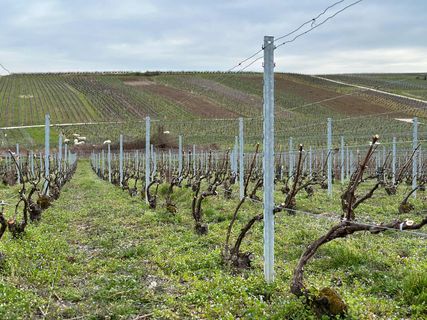
VINE CULTIVATION
Pruning is essential to the vegetative cycle. The aim is to obtain grapes with richer, sweeter aromas.
Seasonal workers help us throughout the year to look after the vines, and there are up to twenty of us at harvest time. We look for the right moment to find the right balance between the sugar (alcoholic degree) and acidity content of the grapes, depending on their state of health. We harvest by hand and sort by plot. Harvesting takes around 10 days, and can vary from year to year.
02
PRESSING
Pressing is one of the most important stages in the champagne-making process.
This stage takes place while the harvest is still in progress, with the grapes arriving directly from the vines at the press.
This crucial stage must be carried out quickly, as the weight of the bunches could alter and oxidise the must.
However, in order to maintain the quality of the bunches, they are always pressed slowly and gently.
03
ALCOHOLIC FERMENTATION
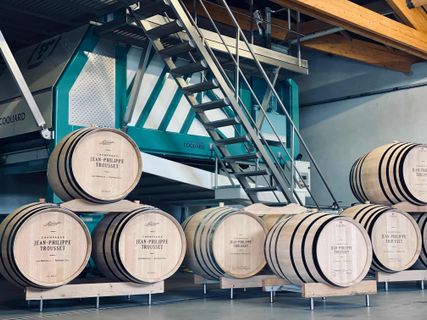
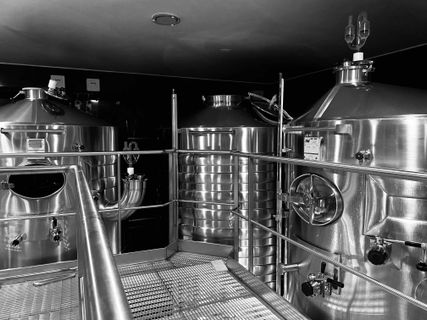
After pressing, the grape juice is vinified in temperature-controlled stainless steel vats and oak barrels: 3 foudres with perpetual reserves (Chardonnay, Pinot Noir and Meunier), 5 demi-muids and 39 barrels. The wines are matured on fine lees for 9 months. Fermentation is carried out with active dry yeasts, which are rehydrated in hot water and must. The must is analysed in the laboratory, and if necessary we add sugar by dry chaptalisation. The ferments are then added to the vat. The temperature is maintained at between 18° and 20° for 15 to 20 days, depending on the year and the acidity and pH levels.
04
BLENDING
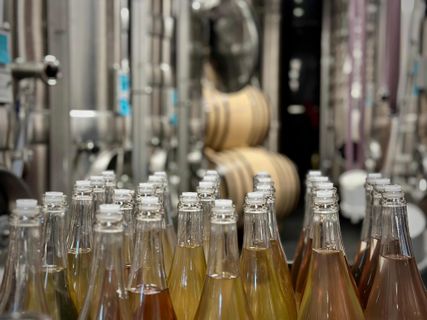
Champagne is a blended wine, combining clear wines from different grape varieties and years. After 9 months, the clear wines are tasted to create the different Cuvées.
Cuvée Parcellaire
"Les Croisettes" plot. Terroir de Sacy.
An old-fashioned grape variety. 100% stainless steel. Sparkling under cork
51% Petits Meslier, 3% Arbane and 46% Chardonnay, 100% stainless steel.
Grape variety collection
Each cuvée is made up of a perpetual reserve and oak barrels:
- Chardonnay Anna T. Extra-Brut. single varietal. Foudre Tonnellerie de Champagne
- Pinot Noir. Extra-Brut. Single varietal. Foudre Tonnellerie Vicard
- Meunier. Brut Nature. Single varietal. Foudre Tonnellerie Rousseaux
Signature range
Vintage Brut Nature: 50% Pinot Noir, 50% Chardonnay.
A single year's harvest, a blend of 2 grape varieties, 100% stainless steel.
Extra-Brut and Brut Nature Terre d' Histoire: 50% Pinot Noir, 30% Meunier, 20% Chardonnay.
Rosé Extra-Brut Terre d' Histoire: 46% Chardonnay, 30% Pinot Noir, 18% Meunier, 6% Red Wine.
These cuvées are made from 55% of the harvest and 45% reserve wines. 90% stainless steel and 10% oak barrels.
05
SECOND FERMENTATION
Since 2017, we have blocked malolactic fermentation on all our wines, to bring freshness and tension, with a beautiful attack and persistence on the palate, prolonging the pleasure. It's a question of style and balance...
06
AGEING
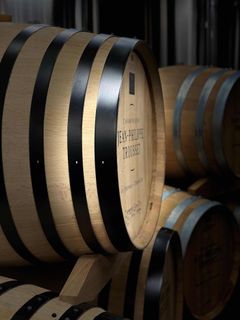
Our wines are aged for a further 9 months on fine lees in temperature-controlled stainless steel vats (1500 hl vats) or in casks: 3 Foudres, 5 Demi-muids, 30 Tonneaux, Cavin, Chassin, François Frères, Rousseaux, Tonnellerie de Champagne).
After filtration and bottling, the wines are left to rest for 15 months for blends and 3 years for vintage wines.

07
RUMBLING
We all know the importance of stirring: stirring each bottle to put the lees back into suspension, which intensifies the finesse of the bubbles and the richness of the aromas. We use a Gyropalette Quadra that turns 4 pallets of 504 bottles in 7 days. Riddling gradually pushes the lees into the neck of the bottle, after which the champagne is stored on its tip (upside down) until it is disgorged.
08
DEFROSTING
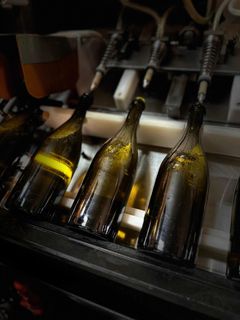
We immerse the neck of the bottle in a refrigerant solution at -30°C for about 10 minutes to freeze the deposit (lees and dead yeast) and facilitate extraction with a minimum loss of wine and pressure, and to add the dose of liqueur corresponding to each cuvée before corking.
Our aim is to be able to follow the Lunar Calendar for bottling and disgorging.
09
DOSAGE
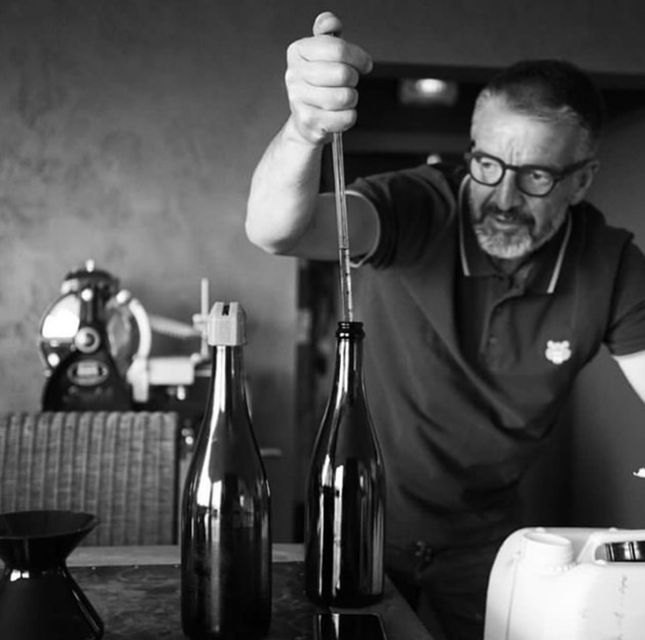
Each time there is a change of bottling and cuvée, we carry out dosage tests to find the best sugar/acid balance for the wine. For each cuvée, we define a dose of MCR liqueur (Moûts Concentrés Rectifiés), a neutral liqueur to preserve the personality of the wine.
Les Croisettes, Brut Nature, dosage 1.15 gr/litre
Chardonnay Anna T. Extra-Brut . dosage 3.50 gr/litre
Pinot Noir . Extra-Brut . dosage 3.50 gr/litre
Meunier, Brut Nature . dosage 2.30 gr/litre
Millésimé 2018 . Brut . residual sugar 7 gr/litre
Extra-Brut . Tirage 2021 . dosage 3.50 gr/litre
Brut Nature. Tirage 2020 . dosage 1.15 gr/litre
Rosé Extra Brut . Tirage 2021 2.30 gr/litre
10
CORKING AND PACKAGING
We use 2 types of corks for our champagnes:
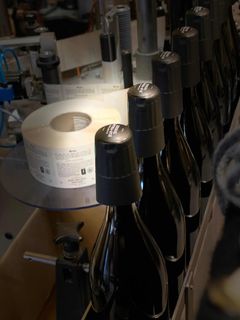
Amorim Fleur: this is a traditional cork with 2 discs of top-of-the-range cork. The Amorim Fleur gives us a beautiful mirror finish and very few dry veins. It's a natural cork that allows an exchange and prevents the wine from closing.
Mytik diamant: this is a technological cork guaranteed to be free of cork taint, offering very high permeability as well as wine homogeneity.
Finally, the bottle will be ready for tasting as soon as the dressing is complete.
Champagne Jean-Philippe Trousset.
Maison familiale de tradition Champenoise produisant des Champagnes de qualité avec une élégance incomparable
About
- Route de Villedommange Bâtiment isolé RD651370 LES MESNEUX
- contact@champagnetrousset.fr
- 06 16 70 32 66